Interactive preview: the compute-joint cross-section, Revision E. Research concepts; no operating facility or flight-qualified design is claimed.
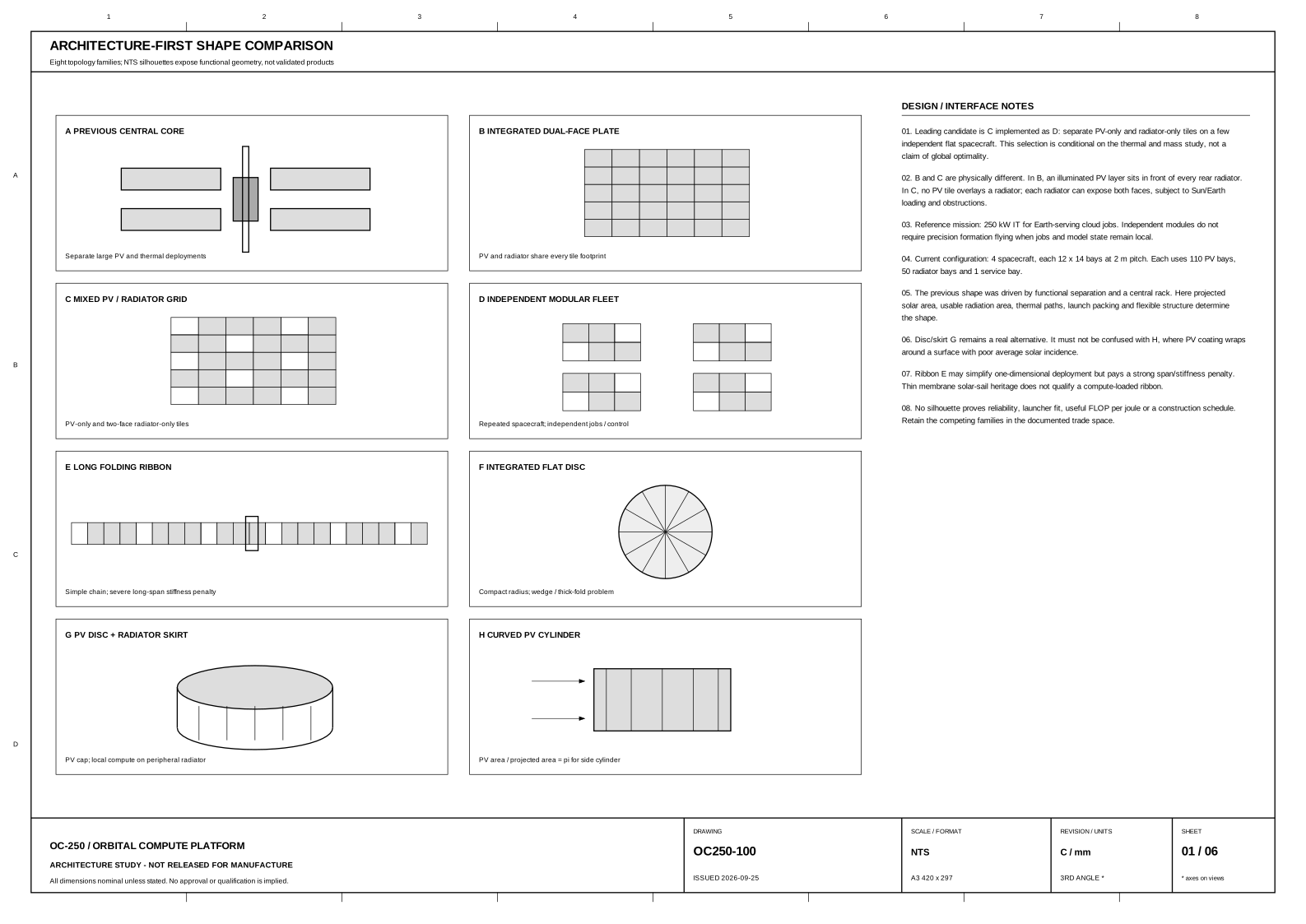
Architecture comparison OC250-100, Revision C, September 25, 2026. Source drawing from the analytical engineering study.
01 / Siting
Compare the whole service.
The siting study compares terrestrial, stratospheric, and orbital architectures using a common computing service. Power delivery, heat rejection, data transport, equipment replacement, and delivery dates all enter the decision.
The preferred location changes with workload and assumptions. The study sets out testable conditions and makes the limits of the available public evidence explicit.
The orbital memorandum links illumination to photovoltaic arrays, batteries, radiator area, mass, networking, launch, and useful-compute cost. It distinguishes data already generated in orbit from Earth-generated jobs that must be transported there.
The commercial case stays conditional on hardware, reliability, network capacity, launch terms, and incremental value to a customer. The memorandum supplies a framework for testing those conditions.
Revision C examines the arrangement of solar collection, heat sources, emitting surfaces, structure, and interconnect. Its provisional reference uses a compact planar mosaic with separate photovoltaic tiles and radiator tiles carrying distributed compute.
Topology, outline, and the number of autonomous spacecraft remain separate choices. Deployment, dynamics, thermal survival, qualified compute, and complete launch mass need further work.
The interactive preview focuses on the compute-joint cross-section from Revision E. The manuscript and architecture drawing on this page are Revision C.